
The 2021 Bengals are one of the most surprising Super Bowl teams in recent memory. An average team for much of the year, the Bengals got hot at the right time and pulled off a late season run that relied mostly on explosive deep passing plays and timely turnovers on defense throughout December and January. Despite this run, Cincinnati was a very flawed team. They could not run the ball, they could not pass protect, they could not sustain long drives, they could not convert in short yardage situations, they were terribly inefficient in the red zone. It is easy to see why many smart analysts in the football community penned Cincinnati down for a regression season that would see them miss the playoffs. Explosive plays and turnovers are very high variance from game-to-game and year-to-year, and if they came back to earth on both of those, what else did they do well?
Cincinnati’s start to the year did very little to silence the doubts of many, with ugly losses to Pittsburgh and Dallas where the offense looked utterly inept. In those two games, the Bengals gave up 13 sacks, had the least efficient running game in the NFL, and turned the ball over countless times. All the same issues from last year still existed, and now the explosive plays and turnover luck was no longer in their favor. The talk all offseason was that teams would run Cover 2 to limit Burrow deep passes to Chase and Higgins with safety help on both sides… and that is exactly what teams were doing. The Bengals were basically trying to run two separate offenses. An under center offense where they ran wide zone run plays over 80% of the time and struggled greatly with play action, and a shotgun offense that passed 80% of the time. Against under center looks, teams would play one high safety and sell out for the run. Against shotgun looks, teams were playing almost exclusively two high safeties and daring the Bengals to run their inefficient shotgun zone runs or throw shorter routes and sustain long drives (neither of which they showed any success of doing in 2021). The NFL had figured out the 2021 Cincinnati Bengals once and for all.

So what the hell changed? Well, somehow the Bengals completely overhauled their offense on the fly. Week 5 against Baltimore was the turning point for the Bengals offense. Even though they saw the Ravens march down for a game-winning field goal after a Burrow rushing TD gave Cincinnati the lead with less than two minutes to play, the Bengals discovered their running game that night. Operating almost exclusively out of shotgun, the Bengals got rid of the outside zone exclusive run scheme. They ran all sorts of gap, trap, wham, zone, and counter runs, and for the first time all year they ran the ball well. Since that game, the Bengals have had the most diverse shotgun run game in the NFL, and ran it extremely efficiently. In the weeks that followed, the offense continued to evolve. With teams sitting in two high, the Bengals began to discover their short and intermediate passing game along with run game. Burrow, known for extending plays, still has that ability, but has been getting the ball out quickly and on time. Always known as a quick processor, Burrow has been taking what the defense is giving him. This season, Burrow has gotten the ball out in less than 2.6 seconds on average, the third quickest in the league. He also has tucked the ball and ran more than years past, showing more confidence in his knee (the brace he wore all of last year is now gone). The three new starters on the interior of the OL (Volson, Karras, and Cappa) have also proven to be massive upgrades from last year. Their ability to keep clean pockets up the middle has allowed Burrow to operate confidently in the pocket. Despite missing Ja’Marr Chase for four games and Joe Mixon for two, since the Ravens game in Week 5, the Bengals are 3rd in the league in Rush EPA/play and 2nd in the league in Dropback EPA/play. They are second to only the Chiefs in overall EPA/play on offense. In simple terms, they are one of the league’s most efficient offenses on both runs and passes. Even with the explosive plays last year, Cincinnati was near league average in both statistics.
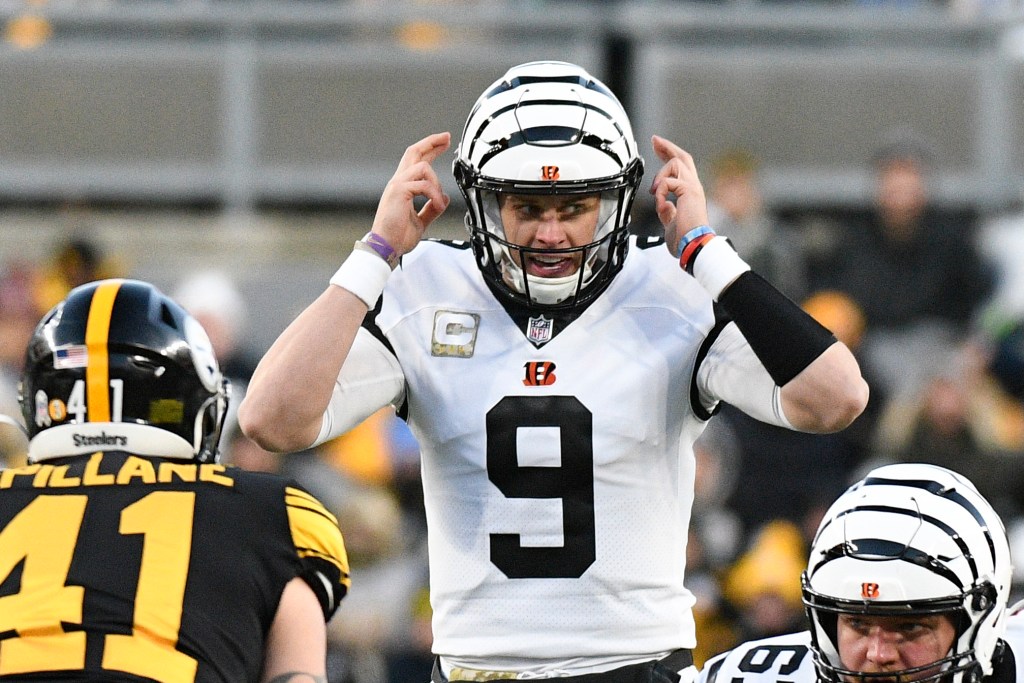
In year 3, Joe Burrow has continued to improve as a QB. He has gained confidence in what he is seeing against defenses and has improved his decision making. Burrow showed his big play ability last year, but the story of this year is him taking less negative plays that can kill drives. According to PFF, since week 2, Burrow has just one turnover worthy play. His turnover worthy play percentage is 1.2%. The best mark in the NFL. One of the main critiscms against Joe last year was that he took too many sacks. His improvements in processing and not always being a “big game hunter” looking for the deep ball have allowed him to take significantly less sacks than both last year and the first few games of this year. During the Bengals current 5 game win streak, he has taken just 6 sacks. Just 12% of pressures conceded by Cincinnati are resulting in sacks, a large improvement from last year. This has led to Burrow’s best run yet. Since Week 2, the third year QB is 1st among QBs in PFF Grade (91.3), 2nd in Yards Per Attempt (8.2), 2nd in Passing TDs (25), and 2nd in Passer Rating (109.2).
Taking short passes when necessary, paired with a more efficient run game has allowed the Bengals to stay ahead of the chains and not get into 2nd and long situations as often. On the rare occurrences where they do face 2nd and long, the Bengals are no longer running the ball and accepting a low percentage 3rd and long. Per Ben Baldwin (@benbbaldwin on Twitter), Cincinnati has an 84% pass rate on 2nd and long (4th highest in the NFL). Reducing these tough 3rd downs has fixed the Bengals boom-or-bust tendencies of last year. No longer are possessions either a long TD or a 3 and out. Per Baldwin’s Drive Conversion Chart, 77% of the Bengals drives result in a touchdown or first down (3rd highest rate in the NFL). They are just as capable of marching down the field as they are at hitting the big play. This variety has allowed them to be a more consistently great offense from drive-to-drive and game-to-game. This success has carried over into the redzone, an area they struggled in last season. Cincinnati scores a TD on 66.67% of their redzone drives, good for 4th in the NFL (they were 23rd last season). Zac Taylor, Brian Callahan, and Burrow all deserve a lot of credit for overhauling this scheme on the fly mid-season to become so efficient.

The Bengals are a far better team than they were last season. However they are not without flaws. At CB, Chidobe Awuzie is out for the season with a torn ACL. Rookie Cam Taylor-Britt has stepped in better than expected, but he and Eli Apple are still a relatively weak outside CB duo. There is also very little depth behind them if either get hurt. The pass rush is inconsistent, oftentimes relying on DC Lou Anarumo to scheme up blitzes or Trey Hendrickson to get home. Hendrickson will miss at least the next few weeks with a broken wrist but should be back by the playoffs. Younger players such as Joseph Ossai, Cam Sample, and Zach Carter need to step up in his absence. Finally on offense, elite EDGE rushers have shown they can wreck games when lined up against Jonah Williams and La’El Collins. Early season games against TJ Watt, Micah Parsons, and Myles Garrett all resulted in losses thanks to dominant performances from 3 of the league’s best. Cincinnati was able to win the rematches against Watt and Garrett, but Garrett still dominated. Luckily for Cincinnati, they will not have to worry about Watt and Garrett in the playoffs, and Parsons is in the NFC, but teams that have an elite EDGE will undoubtedly challenge the Bengals.
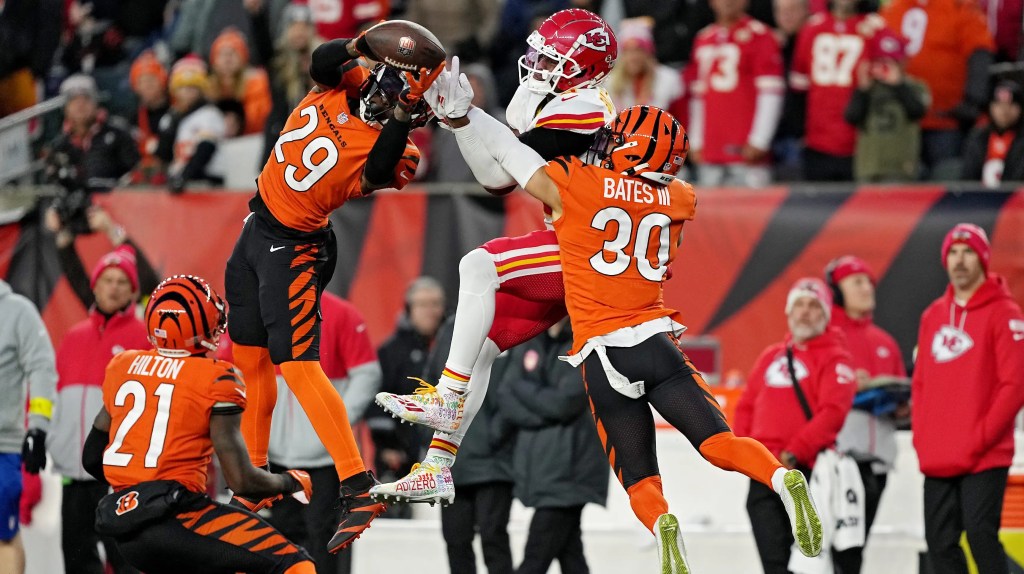
Cincinnati is playing their best football in recent memory and feels like a real contender in December for the first time in a long time. If they can head into the playoffs relatively healthy, they have as good of a shot as anyone. Their schedule is difficult the rest of the way, but as their new slogan says about their tough opponents “They Gotta Play Us.”
 Blog in the Back with Kelley and Lou
Leave a comment